I build and ship AI to real users, publish generative-model research, and teach Computer Science to hundreds of students. I want to bring all three into the classroom for UH's new MS in AI.
My doctoral research sits exactly where this program lives: deep learning, generative AI, and the engineering needed to make models run at scale.
Conditional and physics-guided diffusion models for scientific data, embedding constraints like divergence-free conditions and Helmholtz-Hodge decomposition with geometric priors to produce physically plausible outputs.
Embedding large language models into 3D rendering and visualization pipelines to enable natural-language control, prompt engineering, and human-in-the-loop AI workflows, both in research and in the classroom.
I build fully interactive, cross-platform browser applications that make AI research accessible and usable: from scientific visualization tools to production web services. My research deliverables run in the browser, not just on a workstation, and I extend that same philosophy to large-scale inference by end users through deployed webapps.
A conditional diffusion model that reconstructs a complete vector field from only a handful of sparse streamlines that outperforms traditional optimization methods.
It demanded hands-on proficiency with the same deep-learning foundations the MS in AI's Machine Learning & Deep Learning course is built on: CNN architectures, diffusion-based generative modeling, and training pipelines that respect physical constraints.
R. A. Morales Vargas · S. Espriella · G. Chen , two undergraduate researchers I mentored onto the paper.
Exactly the production-at-scale competencies this program emphasizes: reliability, cost-aware engineering, and serving AI on real infrastructure.
A free, open-source image background remover serving 10 different AI models (Bria, InSpyrenet, U²-Net, Tracer, BASNet, DeepLab, ORMBG, ISNet). A React front end on Cloudflare Pages, a Python/PyTorch backend with multi-GPU acceleration (CUDA & ROCm).
An open-source AI novel-writing suite. The headline engineering story: I deployed a production LLM on a single consumer GPU (RTX 5060 Ti) serving up to 50 concurrent connections, reaching thousands of users a month on cost-aware, right-sized hardware.
Both are FOSS, open-sourced on GitHub for the community.
Across COSC 1336, 2306, and 4370 I've woven AI into how students learn, build, and explore, with a deliberate focus on making instruction intuitive and accessible.
I designed an assignment where students control a live 3D scene through natural language: adding and removing objects, changing textures and colors, animating elements. The real lesson is prompt engineering: students rewrite the system prompt to make the LLM manipulate the world more reliably.
Live, right now. Interact with it during the talk. Connects classic graphics to Generative & Agentic AI.
For COSC 2306 and 4370 I built dedicated lecture sites with live, interactive demos so abstract methods become something students can touch. Everything stays publicly accessible, anytime.
COSC 2306 · Data Programming: lectures and interactive data-structure demos.
COSC 4370 · Computer Graphics: lectures and interactive rendering demos.
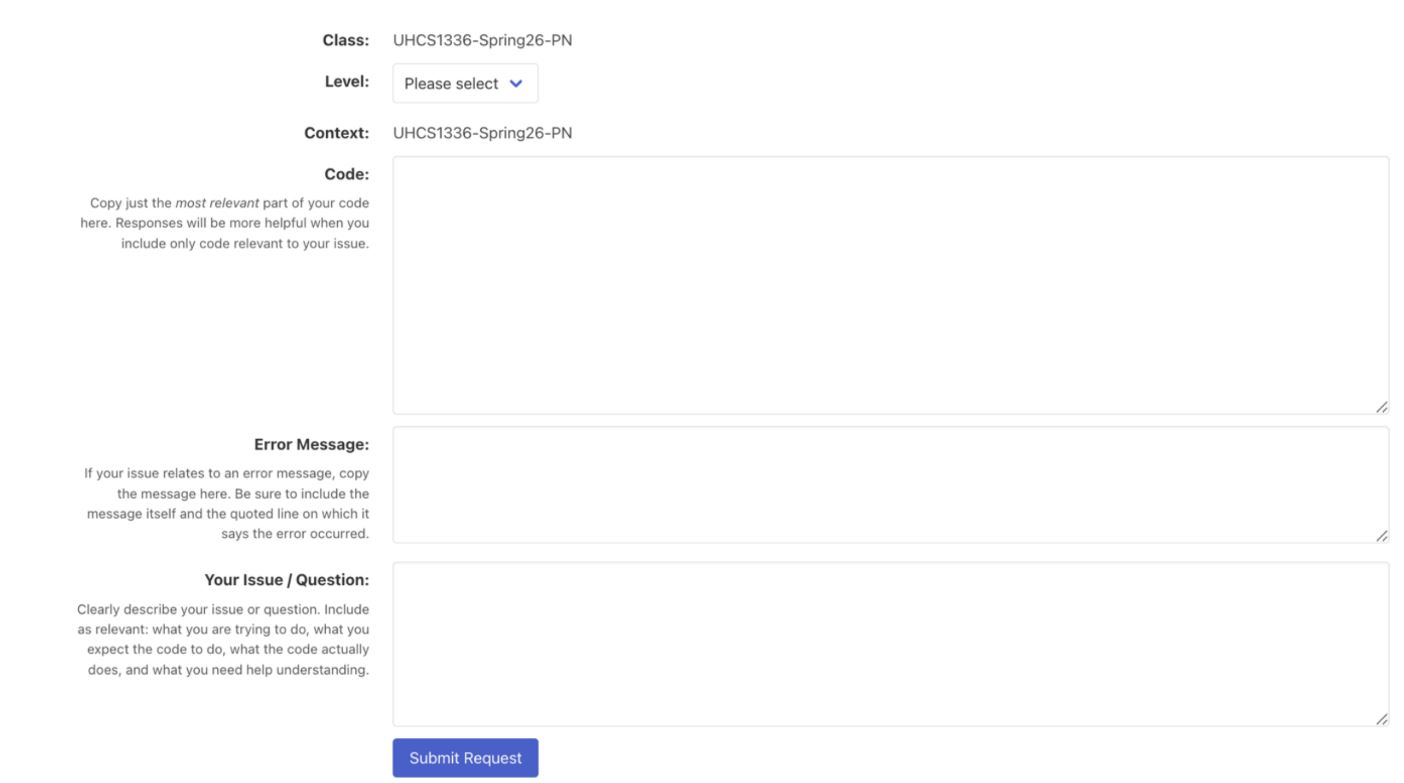
In my intro course I adopted CodeHelp, an AI assistant that scaffolds students toward their own solution rather than spitting out code. Students use it freely on exercises and practice exams; it lowers the anxiety of a first programming course without short-circuiting the learning.
Built by Somaia Alhazmi, a UH Ph.D. student researching AI in education. I value collaborating with peers advancing the field.
For a student with special needs in a visualization course, I modified the assignments, volunteered as his project groupmate, and helped him prepare and deliver his final presentation.
He completed the course with new confidence. Every student deserves the adaptations they need to succeed.
Fair, scalable assessment and a serious, practical approach to integrity in an age of AI-assisted work.
For COSC 6344 (Scientific Visualization) I helped build an auto-grading system tailored to the Trame/VTK web framework, where standard scripts fall short, giving consistent assessment and freeing time for qualitative feedback on design decisions.
I embed invisible, hard-to-detect "canary" instructions in assignment and exam prompts. Submissions that blindly paste an AI's response surface immediately: a low-friction signal that catches misuse without burdening honest students.
A custom card-reader app logs both entry and exit times for in-person exams, cross-checked against submission timestamps, confirming work was done under exam conditions, not before or after.
Responsible AI starts with assessment students can trust is fair.
I met weekly with undergraduate and high-school researchers, building confidence, teaching methodology, and guiding real contributions. Many earned co-authorship on major publications.
Mentorship is, to me, one of the most valuable things a faculty member offers, and I'm eager to do it for the MS in AI.